Create superhero avatar: From selfies to your own hero
Create superhero avatar with AI: learn prompts, concept, and steps to bring your personalized hero to life.
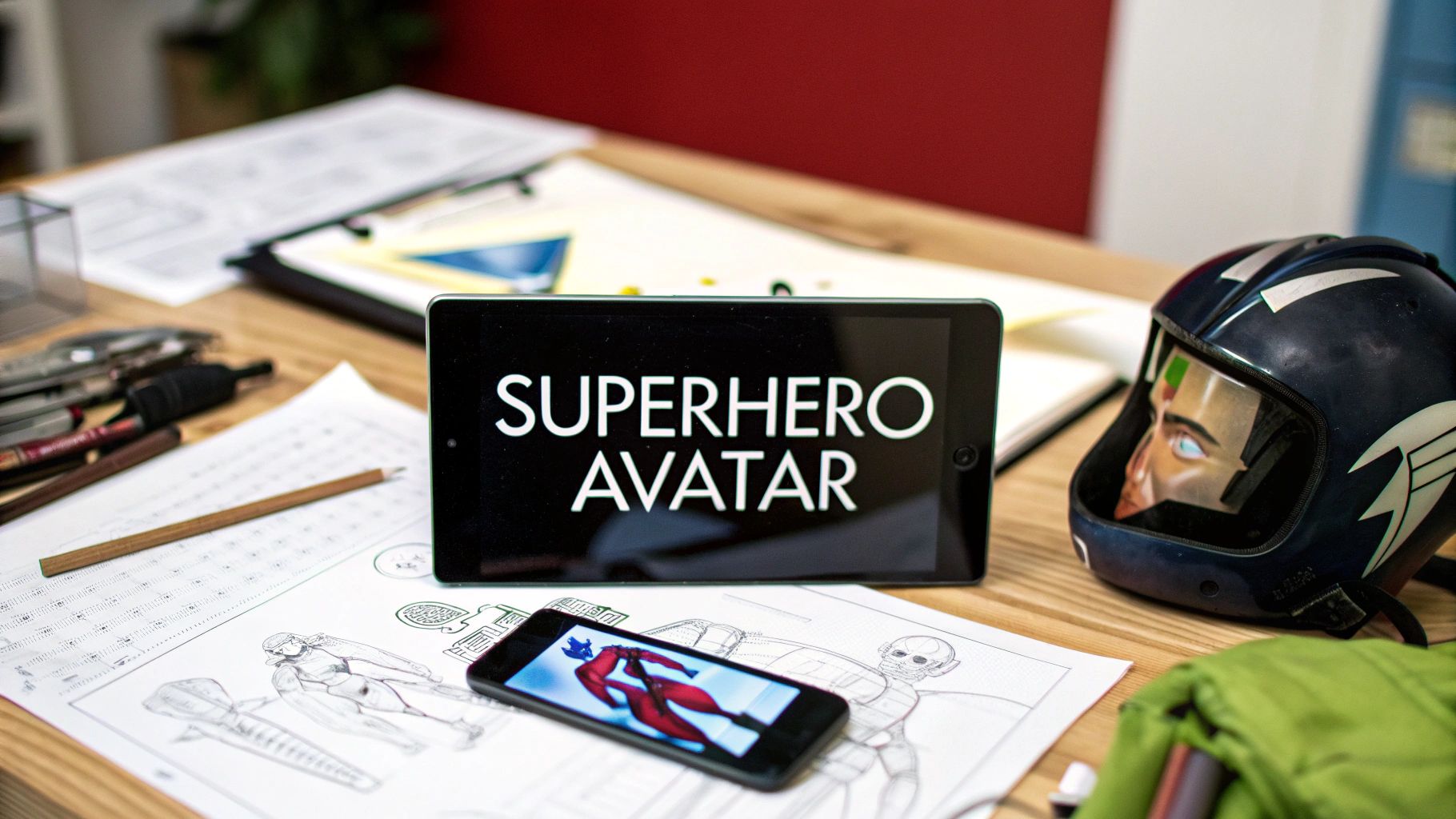
Ever thought about turning a selfie into a full-blown superhero? It's not just a cool party trick anymore; with the right AI tools, you can craft a powerful heroic persona in just a few minutes. This isn't just for fun—it's a serious strategy for building a standout online brand.
From Selfie To Superhero In Minutes
Let's be honest, the digital world is noisy. Standing out requires something special, and a custom superhero avatar is a fantastic way to cut through the clutter. This is more than just a passing trend; it’s a powerful tool for branding and content that allows anyone, from streamers to artists, to build a unique identity that grabs attention.
What started as a niche hobby in cosplay forums has exploded. The global market for AI avatars is already massive, sitting somewhere between USD 7.41–10.4 billion. But get this: forecasts show it rocketing past USD 110 billion by 2034. That's a growth of more than 10 times in under a decade, which tells you everything you need to know about the demand for unique digital identities.
The Modern Hero Creation Process
The magic here is in the simplicity. You bring the human touch—your face—and the AI handles the epic transformation. It’s this fusion of your real-life likeness with a larger-than-life concept that makes the final result so captivating.
The whole thing boils down to a pretty straightforward workflow.
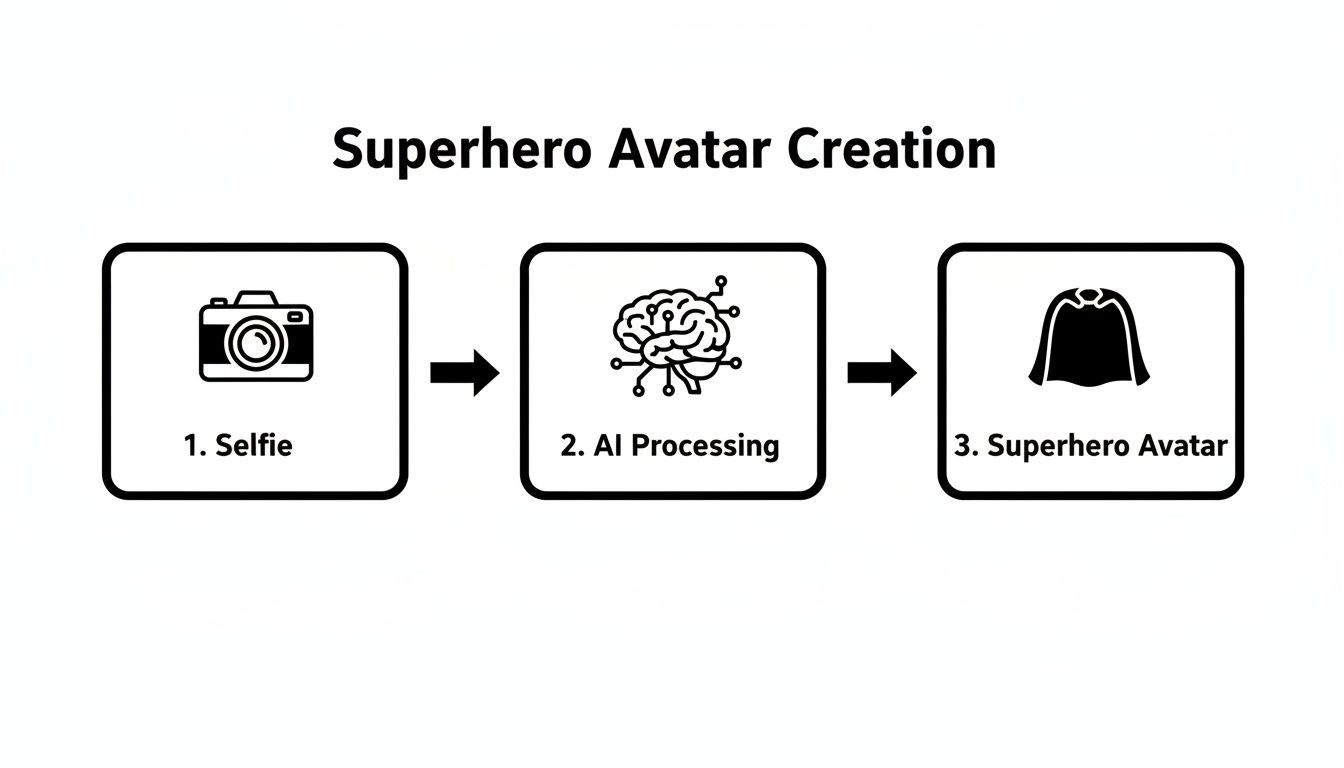
As you can see, it’s a simple three-part journey. This accessibility means anyone, regardless of their tech skills, can jump in and start creating.
To give you a clearer picture, here's a quick overview of the key stages involved in bringing your superhero persona to life.
Your Superhero Avatar Blueprint
| Stage | Focus | Key Outcome |
|---|---|---|
| Concept & Foundation | Planning your hero's look and capturing a good selfie. | A clear vision and a high-quality base image. |
| AI Transformation | Choosing a tool and crafting the right prompt. | A stunning, AI-generated superhero avatar. |
| Refinement & Launch | Editing, upscaling, and sharing your creation. | A polished, ready-to-use avatar for any platform. |
This blueprint strips away the complexity, leaving you with a clear path from a basic idea to a finished, eye-catching hero.
Why A Superhero Avatar Matters
In a sea of generic profile pictures, a memorable avatar is your digital handshake. It’s the first impression you make and a brilliant way to cement your brand identity. If you're creating content on Twitch, TikTok, or Instagram, a superhero persona makes your work instantly recognizable.
A superhero avatar does more than just look cool—it builds an immediate narrative around your online presence. It tells your audience you're creative, bold, and ready to stand out from the crowd.
This is fundamentally about engagement. A unique avatar sparks curiosity and often leads to more likes, comments, and shares. To get started quickly, specialized AI image generator tools are your best friend. They handle the heavy lifting, letting you focus on the creative side of things.
If you want to dig into the basics first, our guide on how to create an AI avatar from a photo at https://createinfluencers.com/blog/create-ai-avatar-from-photo is a great starting point. Here, however, we’re diving deep into the art of the superhero. Let’s get you suited up.
Laying the Groundwork: Who Is Your Hero?
Before you jump into the fun stuff with AI prompts and image generation, we need to take a step back. The single most important part of this whole process is figuring out who your hero is. A slick design is great, but without a story, it's just an empty suit. A real identity gives your avatar a soul, turning it from a cool picture into a character people can actually connect with.
This foundational work guides every single creative choice you'll make later—from the colors on their costume to the look in their eyes. Getting this right makes the rest of the process worlds easier and ensures your final avatar feels consistent and authentic.
Start With an Archetype
Let's begin with the big picture. What kind of hero are you making? Think of archetypes as a creative shortcut—a familiar starting point that you can build upon and twist into something new.
- The Tech Genius: This hero's power comes from their brain and their gadgets. Think Iron Man or Batman. Their look is often sleek, metallic, and modern, with lots of clean lines.
- The Mystical Guardian: Power here flows from magic, ancient artifacts, or cosmic energy. Doctor Strange and Scarlet Witch are great examples. You'd expect to see flowing fabrics, intricate symbols, and maybe some ethereal, glowing colors.
- The Powerhouse: Whether they're an alien, a mutant, or a lab experiment gone right, this hero is all about raw strength and near-invincibility. Think Superman or Captain Marvel. Their designs are usually bold, confident, and often use primary colors.
- The Street-Level Vigilante: This is the gritty, grounded hero protecting their neighborhood. Think Daredevil or Green Arrow. Their costumes are almost always practical, darker, and designed for stealth and combat, not for showing off.
Picking an archetype gives you an instant framework. You immediately know if your hero solves problems with a supercomputer, a magic spell, or just their fists. This is the first, crucial layer of your avatar's personality.
Pro Tip: The best superhero avatars often reflect a personal brand or content niche. Think about the message you want to send. Is it about innovation? Empowerment? Resilience? Let your hero's identity echo that theme.
Give Them a Backstory and a Moral Compass
Okay, now for some depth. A backstory, even a simple one, is what drives a character. You don't need to write a three-act screenplay, just jot down a few key ideas to give your hero some motivation.
Ask yourself these quick questions:
- Origin Story: How did they get their powers? Were they born this way, did they build a suit, or was there an accident? This simple detail shapes how they feel about their own abilities.
- Core Motivation: Why are they a hero? Are they out for justice? Are they protecting the innocent? Maybe they're trying to make up for a past mistake. This is the engine that drives them.
- Personality Quirks: What are they like when they're not saving the day? Are they a sarcastic genius? A stoic guardian? An unshakably optimistic leader? This will directly influence the poses and expressions you generate later.
Their moral compass is a big one. Are they a pure symbol of hope, or more of a gritty anti-hero who doesn't mind bending the rules? That one decision can completely flip the visual theme, taking you from bright, inspiring colors to a dark, menacing palette. If you want to dive deeper into crafting a compelling character, we've got more tips in our guide on how to create your own superhero.
Nail Down a Visual Theme and Color Palette
With a personality in place, it’s time to think visually. This is where you connect your hero's story directly to their look. A hero born from a chaotic lab explosion might have an asymmetrical, jagged design. A mystical guardian, on the other hand, would probably have elegant, symmetrical patterns.
And then there’s color. Color psychology is a powerful storytelling tool that instantly communicates a vibe.
| Color | Common Heroic Association | Example Scenario |
|---|---|---|
| Red | Power, passion, determination, danger | A hero driven by intense emotion or raw strength. |
| Blue | Trust, wisdom, stability, calmness | A tactical leader or a hero with intellectual powers. |
| Green | Growth, nature, healing, ambition | An eco-warrior or a character with regenerative abilities. |
| Black | Sophistication, mystery, stealth, power | A stealthy vigilante or a hero with a serious, no-nonsense attitude. |
| Gold | Divinity, prestige, power, nobility | A god-like hero or one with royal lineage. |
Try not to stick to just one color. A truly memorable design usually has a palette of two or three complementary colors. Just think of Superman's red, blue, and yellow—it’s iconic for a reason.
By nailing down these core identity elements first, you aren't just crossing your fingers and hoping the AI spits out something cool. You're giving it a clear blueprint to build a superhero avatar that is genuinely, uniquely yours.
Crafting AI Prompts That Get Results
This is where the real fun begins. You've done the hard work of planning your hero's identity, backstory, and look. Now, it's time to translate that vision into clear instructions for the AI. Think of yourself as an art director guiding an incredibly fast and talented artist. Your job is to be specific, because the AI takes everything you say literally.
Effective prompting isn't about knowing code; it's about descriptive language. If you're vague, you'll get vague, generic results. But a carefully crafted prompt? That's how you get a jaw-droppingly cool superhero avatar that actually looks like you.
This is pretty much what my desk looks like when I'm deep in a prompting session. It’s a simple setup—just you, your ideas, and the text box where you bring your hero to life.
The Anatomy of a Powerful Prompt
A killer prompt for a superhero avatar is built from a few key ingredients. You won't always need every single one for every image, but learning to combine them gives you some serious control over the final product. I like to build my prompts layer by layer, starting with the absolute must-haves.
- Subject: This is your hero's core concept. It should include a clear physical description, referencing the selfie you've used for training.
- Costume: Don't just say "red suit." Get specific! Describe the texture (matte, metallic, carbon fiber), the fit (form-fitting, armored plates), and any unique details (glowing chest emblem, tattered cape).
- Pose & Action: Is your hero standing defiantly on a skyscraper? Leaping into a fight? Or hovering with energy crackling in their hands? An active pose immediately injects drama and personality.
- Setting: Where is this all happening? A futuristic cityscape at night sets a totally different mood than a mystical ancient ruin or a stark, sterile white void. The background tells a story.
- Art Style & Modifiers: Here's where you define the whole aesthetic. Use terms like hyperrealistic, cinematic lighting, 8k resolution, Unreal Engine 5 render, or even classic comic book art style.
It’s just like building a sentence. The more descriptive words you toss in, the more detailed and impressive the AI's "drawing" will be. For a more detailed breakdown, you can check out this guide on https://createinfluencers.com/blog/ai-image-prompts.
Prompt Templates You Can Use Today
Alright, let's make this practical. Here are a couple of my go-to templates that you can copy, paste, and tweak. Just swap in the details from your own hero's concept sheet and see what you get.
Template 1: The Cinematic Powerhouse
A hyperrealistic full-body portrait of a female superhero with [your facial features]. She wears a sleek, form-fitting suit of [color] and [secondary color] with glowing [color] accents on the chest and forearms. She is hovering mid-air, hands crackling with [type of energy, e.g., blue electrical energy], with a determined expression. The background is a rain-slicked futuristic city street at night, with neon signs reflecting on the wet pavement. Cinematic lighting, dramatic shadows, 8k resolution.
Template 2: The Gritty Street-Level Vigilante
A gritty, realistic photo of a male superhero with [your facial features] perched on a rooftop gargoyle, overlooking a dark city. He wears a practical, tactical suit made of [material, e.g., dark leather and kevlar], with a hood casting a shadow over his face. The mood is dark and serious. Shot with a telephoto lens, shallow depth of field, muted colors, film grain.
Key Takeaway: See how detailed that is? We’re not just saying "superhero." We're calling out the suit's material, the lighting, and even the style of camera lens. That's the secret sauce that separates a generic AI image from something that looks truly professional.
Advanced Techniques for Flawless Results
Once you get the hang of the basics, you can start playing with some more advanced tools to really dial in your images.
Using Negative Prompts
A negative prompt is your best friend for cleaning up common AI weirdness. It's a simple instruction that tells the AI what not to include. If you keep getting mangled hands or extra fingers (a classic AI problem), just add a negative prompt to your command.
--no poorly drawn hands, extra fingers, blurry, watermark, text
Controlling Camera Angles
Want to create a more dynamic shot? Tell the AI exactly where to put the "camera."
- Low-angle shot: Makes your hero look powerful and larger than life.
- High-angle shot: Can make your hero seem more vulnerable or emphasize the scale of their surroundings.
- Dutch angle: Tilting the camera adds a sense of unease or frantic action.
- Close-up shot: Perfect for capturing your hero's expression and emotion.
The demand for unique digital personas is absolutely exploding. The digital avatar market was valued at a huge USD 18.19 billion and is forecast to reach an unbelievable USD 270.61 billion by 2030. With interactive avatars growing at a rate of over 50% each year, a well-designed superhero persona is a fantastic way to stand out.
To really nail your hero's personality, it's worth checking out resources that show you how to create your own AI influencer and virtual persona. After all, a great character is about more than just a cool costume.
Bringing Your Hero to Life With Video and Voice
A stunning image is your hero’s calling card, but an avatar that moves and speaks? That’s how you build a real connection. Static images get likes, but dynamic videos build a following. This is the moment you take your creation from just a cool picture to an unforgettable digital persona.
It used to take complex software and a ton of time to animate a character. Now, with the right AI tools, it’s remarkably straightforward. You can make your hero speak, react, and pull off heroic feats with just a few clicks or a well-crafted prompt. This opens up a massive playground for content on TikTok, Instagram Reels, and YouTube Shorts, where motion is everything.
Animating Your Avatar With Video Prompts
If you've gotten the hang of writing image prompts, you're already halfway there. The big difference with video is adding the element of motion. You're no longer describing a single frozen moment; you're describing a sequence of actions. Think of yourself as a mini-movie director, not just an art director.
You need to think in terms of action verbs and transitions. Your prompt should tell a tiny story. For instance, instead of just a hero standing on a roof, you'd describe them landing, standing up, and surveying the city below.
- Start with your base image prompt: Take the detailed description of your hero that you know gives you great results for static images. This keeps the look consistent.
- Layer in motion descriptors: Get familiar with vivid verbs. Words like "soaring," "leaping," "unleashing," and "glancing" are your new best friends.
- Direct the camera: Don't forget you're also the cinematographer. Adding terms like "slow zoom in," "tracking shot," and "crane shot up" can give your clips a much more professional, cinematic vibe.
Here’s a quick look at how an image prompt can evolve into a video prompt:
Video Prompt Example:
A superhero with [your facial features] lands powerfully on a skyscraper ledge, a puff of debris kicking up. He slowly stands, his tattered cape billowing in the wind as he looks out over a neon-lit city at night. Slow tracking shot moving around him. Cinematic, 4k.
Giving Your Hero a Voice
An animated avatar is cool, but one with a voice feels real. This is where you can inject so much personality. Is your hero’s voice deep and commanding? Quick and witty? Or maybe something more robotic and synthetic? AI voice synthesis tools let you find the perfect match for the character you’ve designed.
Many platforms have libraries of pre-made voices, but the real fun begins with real-time voice synthesis. This tech lets you use your own voice to make the avatar speak, mirroring your inflections and even controlling its facial expressions. It’s a complete game-changer for creating reactive content like livestreams or Q&A videos.
This real-time synthesis is incredibly powerful. It closes the gap between you and your digital persona, allowing for spontaneous and authentic interactions that scripted animations just can't match. Your personality directly drives the performance.
The process is usually simple: you either upload a script or just speak into your microphone. The AI then maps your vocal patterns onto your avatar's model, creating a pretty seamless performance.
If you want to get into the nitty-gritty, we've put together a full tutorial on how to create a talking avatar right here on our blog. It breaks down the steps for making your hero speak fluently and with genuine expression.
By combining AI animation with a compelling voice, you're not just making a digital asset—you're creating an active, engaging character. That dynamic presence is what will grab people's attention and build an audience that can't wait to see what your hero does next.
9. Turning Your Hero into a Moneymaker
You've done the creative work. Your superhero has a look, a voice, and a story. But what you’ve built isn't just a cool digital puppet—it's a genuine digital asset. Now comes the exciting part: making that asset work for you. This is where your creative project can start turning into a real business.
First things first, you need to look the part. A blurry or pixelated hero just won't cut it. Before you even think about monetization, you have to ensure your visuals are absolutely pristine. This is where AI upscaling tools, like the HyperReal engine we have built-in, are non-negotiable. They take a standard image and blow it up to stunning HD quality, ensuring your hero looks sharp and professional on every screen, from a tiny profile icon to a massive monitor.
Polishing Your Hero for Prime Time
Once your images are crisp and high-resolution, a few final tweaks can elevate them from good to great. You don't need to be a Photoshop expert. Simple adjustments to lighting, contrast, and color can make a world of difference. Make that costume pop. Give their eyes that heroic glint. Think of it as the last touch-up before the big premiere.
These small refinements are what separate a hobbyist's creation from a professional-grade character that people will actually pay for. A polished, high-res hero is just far more compelling to potential fans, followers, and paying clients.
The Direct Route: Selling Exclusive Content
With your avatar looking sharp, let's talk about the most straightforward way to make money: selling exclusive content packs. People have already bought into your hero's look and backstory, so give them a chance to get more.
This can play out in a few different ways:
- Themed Photo Sets: Drop collections of your hero in unique scenarios. Think "Summer Vacation," "Cyberpunk Undercover," or a "Holiday Special."
- Behind-the-Scenes Access: People love seeing how the sausage is made. Offer up your original prompts, early design drafts, or even the storyboards you used for your video clips.
- Custom "Cameo-Style" Videos: This is a huge one. Offer to create personalized video shout-outs from your superhero persona for a fee.
Platforms like Fanvue, Fansly, or Patreon are built for this exact model. They handle the paywall and the platform, so you can focus on building a recurring revenue stream from your most dedicated fans by consistently delivering content they can't get anywhere else.
A superhero avatar is a brand. By creating exclusive content, you're not just selling images or videos; you're selling a closer connection to that brand and the character you've brought to life.
Your Hero as a Brand and Marketing Powerhouse
Beyond direct sales, your superhero persona is an incredibly powerful marketing tool. Businesses are always on the hunt for fresh, attention-grabbing ways to market, and a unique AI hero can be the perfect brand ambassador.
Let your imagination run wild with the possibilities:
- Social Media Management: What if your hero ran a brand's social media account? It's a unique hook that can make a company's feed way more engaging than the standard corporate fare.
- Sponsored Content: As you grow your following, brands will pay you to feature their products. Picture your hero sipping a certain energy drink before a big fight or using the latest smartphone.
- Digital Ad Campaigns: Your avatar can become the face of a marketing campaign, lending their heroic and trustworthy image to promote anything from video games to fitness apps.
This strategy effectively turns your creation into an influencer. The market for AI-driven influence is blowing up, and having a one-of-a-kind character gives you a massive head start. If you're curious about the different ways to generate income with artificial intelligence, you can learn more about making money using AI in our detailed guide.
Superhero Monetization Models
So, which path is right for you? It really depends on your goals, how much time you can commit, and what kind of audience you're building. To make it clearer, let's break down the most common strategies.
| Strategy | Platform | Effort Level | Potential Return |
|---|---|---|---|
| Exclusive Content | Fanvue, Patreon, Fansly | High (requires constant creation) | High (direct fan support) |
| Sponsored Posts | Instagram, TikTok, YouTube | Medium (requires audience building) | Medium to High |
| Brand Ambassadorship | Direct partnership with companies | Low to Medium (once secured) | High (stable contracts) |
| Digital Product Sales | Your own website, Gumroad | Medium (creation & marketing) | Variable (depends on sales) |
Honestly, the most successful creators rarely stick to just one. A smart approach is to blend these models. You might start by selling exclusive content on Fanvue to build a loyal, paying fanbase, then leverage that audience to attract bigger brand partnerships down the line. Your superhero avatar is a flexible asset—don't be afraid to experiment and see what works for you.
Got Questions About Your AI Superhero? Let's Unpack Them.
As you start bringing your own superhero to life, you're bound to run into some questions. This is new territory for a lot of people, so wondering about the process, the rules of the road, and how to nail the perfect look is completely normal. Let’s tackle some of the most common things that come up.
Getting these answers sorted out will help you push forward with confidence, turning any potential creative hurdles into simple, clear steps.
Can I Really Put My Own Face on a Superhero?
You absolutely can, and honestly, it's one of the coolest parts of this whole process. This technique, often called selfie-to-avatar generation, is designed to use a clear photo of your face as the core reference for the AI.
This means your final superhero avatar will actually look like you, blending your facial features with whatever epic concept you've dreamed up. It’s a game-changer for personal branding because your audience can connect with the person behind the hero. For the best results, start with a well-lit, forward-facing photo with a fairly neutral expression—it gives the AI the cleanest data to work with.
What’s the Deal with Legal and Ethical Stuff?
This is a big one, and it's smart to ask. The legal world is still catching up to AI art, but the general rule of thumb is this: the platform you use to create superhero avatar images usually grants you a license for the art you generate. This often includes commercial use, but you should always glance at their terms of service to be sure.
On the ethics side, two things really matter: transparency and originality.
- Transparency: It’s just good practice to let people know your avatar is AI-generated. It builds trust and keeps things straightforward with your audience.
- Originality: Steer clear of making direct copies of well-known, copyrighted heroes. Drawing inspiration is one thing, but creating a carbon copy of a character from a big franchise can land you in hot water.
The big idea here is to be open about how you made your hero and creative enough to make it your own. This approach keeps you safe legally and helps you build a more genuine connection with your community.
How Do I Keep My Superhero Looking Consistent Across Different Images?
Consistency is what separates a random cool picture from a recognizable character. When people see an image, you want them to instantly know it’s your hero. The best way I've found to do this is by creating a simple "character sheet" for yourself.
First off, save your best and most detailed text prompts. Jot down the exact keywords and phrases that got you the look you love. Then, document your hero’s key visual traits in one spot.
- Costume Details: Be specific about materials, patterns, and symbols. For instance, "matte black carbon fiber suit with glowing crimson circuitry."
- Color Palette: Use precise color names or even hex codes to lock in the look.
- Unique Features: Make a note of any signature hairstyles, scars, or markings that make your character unique.
Some of the more advanced tools also let you "lock in" a character model trained on your selfie. This feature is a lifesaver, as it helps the AI reproduce the same person in all sorts of different scenes and poses, making consistency a whole lot easier.
What if the AI Just Isn’t Getting My Vision Right?
Don't sweat it. This happens to everyone and is a totally normal part of working with AI. Your first few generations are often just a starting point—think of them as a rough draft, not a final product.
If the first image isn't quite there, your first move should be to tweak your prompt. Get more specific. Instead of "red suit," try describing it as a "sleek, form-fitting crimson suit with armored shoulder plates." The more detail you feed the AI, the less it has to guess.
Next, learn to love negative prompts. This is where you tell the AI what you don't want to see. If you’re getting weird-looking hands or blurry backgrounds, adding things like "--no blurry, extra limbs, watermark" can work wonders to clean up the result.
Finally, always generate a few variations from the same prompt. Most tools let you create a batch of 4 or more images at once. This gives you options, allowing you to pick the strongest one and refine your ideas from there. It's all about a little trial and error until you land on that perfect heroic shot.
Ready to forge your own legend? CreateInfluencers gives you the power to transform a simple selfie into a stunning, high-definition superhero avatar in minutes. Start creating for free and bring your heroic vision to life today!