The Ultimate Guide to Crafting a Social Media Hook That Stops the Scroll
Stop the scroll with a powerful social media hook. Learn proven frameworks, psychological triggers, and AI-driven examples to capture attention instantly.
So, what exactly is a social media hook? Think of it as the first one to three seconds of your content—that make-or-break moment designed to stop someone mid-scroll. It's a carefully crafted mix of visuals, text, and sound that has one job: to make an instant impression and convince someone to stay.
Why Your First Three Seconds Matter Most
We live in an attention economy, and on social media, you don't have minutes to win someone over. You have seconds. Your content is just a tiny drop in an endless river of posts, and if your opening doesn't immediately scream value, intrigue, or entertainment, it's gone. Swiped away without a second thought.
This isn’t just a hunch; it’s baked right into the algorithms. Platforms like TikTok, Instagram, and YouTube Shorts are obsessed with early engagement. When your hook keeps people watching past that critical three-second mark, it sends a powerful signal to the algorithm: "Hey, this content is good." In return, the platform rewards you by pushing it to more people, creating that viral snowball effect we're all after.
The New Rules of Engagement
The sheer volume of content out there has completely rewired how we consume information. It’s a crowded world. Active social media users are projected to hit 5.24 billion by 2025, up from just over 2 billion in 2015. With two-thirds of the planet on these apps, the fight for eyeballs is more intense than ever.
This is why a killer hook isn't just nice to have; it's essential. It does a few key things right away:
- It breaks the pattern. A good hook shatters the mindless scrolling rhythm with something unexpected.
- It sets expectations. It quickly tells the viewer what they're going to get out of your content.
- It creates curiosity. It can pose a question or present a puzzle that people feel a genuine need to solve.
- It establishes the tone. It instantly signals if your content is funny, educational, serious, or dramatic.
A great hook doesn't just get you a view. It earns you the viewer's undivided attention for the moments that follow. It's the key to better watch time, more engagement, and a real connection with your audience.
The table below breaks down the key ingredients of a hook that actually works. Think of it as a recipe for grabbing and holding attention.
Anatomy Of a High-Performing Social Media Hook
| Component | Purpose | Example Application with CreateInfluencers |
|---|---|---|
| Visual Trigger | An eye-catching image or video clip that stops the scroll instantly. | Use an AI-generated avatar in a shocking or surreal setting to make users do a double-take. |
| Intriguing Question | Poses a problem or question that the audience wants an answer to. | Open with text overlay: "Did you know your phone has a secret feature?" paired with a dynamic visual. |
| Bold Statement | A controversial or surprising claim that challenges common beliefs. | A voice-driven snippet stating, "Everything you know about making money online is wrong." |
| Promise of Value | Clearly states what the viewer will gain from watching. | Show a quick "before and after" generated with AI photo tools, promising to reveal the secret. |
| Pattern Interrupt | An unexpected sound, visual, or edit that breaks the feed's monotony. | Start with a jarring, fast-paced video open created in the editor, completely different from typical content. |
Mastering these components gives you a repeatable formula for creating openings that demand attention from the very first frame.
Gaining an Instant Advantage
For years, crafting a stunning opening meant you needed expensive gear, complicated software, or a whole production team. It was a huge barrier that left a lot of talented creators behind. But that’s all changing, thanks to AI.
Tools like CreateInfluencers let you generate incredible AI avatars, dynamic video intros, and one-of-a-kind photo concepts that serve as powerful visual hooks. Imagine kicking off your video with a hyper-realistic character that perfectly matches your brand's vibe or creating a mind-blowing "before and after" shot in just a few seconds.
This kind of technology gives you a massive competitive edge. It's not about who has the biggest budget anymore; it's about who has the best ideas.
By getting really good at the art of the hook, you can make sure your message doesn't just reach people but grabs them from the very first second. Learning how to create viral content almost always begins with mastering this one crucial skill. For more on why those first few seconds are so vital, it's worth reading up on the critical role of a powerful hook in boosting watch time.
The Psychology Behind a Scroll-Stopping Hook
A great social media hook isn't just a clever line or a pretty picture. It's a direct line into human psychology. To actually stop someone's thumb mid-scroll, you have to get inside their head and understand the triggers that make our brains jolt to attention. This isn't about gaming the algorithm; it's about connecting with the way people are wired.
The most effective hooks don't just give information—they create an itch the viewer desperately needs to scratch. This is the magic behind what's known as the curiosity gap.
Mastering the Curiosity Gap
The curiosity gap is that powerful space between what someone knows and what they want to know. When your hook cracks that gap open, it triggers a mental need that can only be satisfied by watching your content. It’s the secret sauce behind every "you won't believe what happened next" video that has ever existed.
Think about it. Instead of a flat statement like, "I redecorated my bedroom," you create a hook that opens a curiosity gap: "I made one tiny change to my bedroom, and it saved me $500 a year."
Suddenly, the viewer's brain is firing off questions. What was the change? How could a decoration save that much money? They have to stick around to get the answer.
Here are a few ways to create this effect:
- Ask a provocative question: "Is your morning coffee actually making you more tired?"
- Hint at a surprising outcome: "I tried the 'lazy girl' workout for 30 days... and the results were not what I expected."
- Tease a secret: "There's one Canva feature 99% of people don't know about, and it's a game-changer."
Using a tool like CreateInfluencers, you can take this even further. Imagine generating an AI avatar with a comically shocked expression, paired with a text overlay asking a killer question. That visual-text combo is a one-two punch that makes scrolling past almost impossible.
A great hook doesn't give away the answer; it makes the viewer feel like they need to find it. The more compelling the mystery, the stronger the pull.
Using Loss Aversion to Your Advantage
Another potent psychological lever is loss aversion. We're wired to feel the pain of a loss much more intensely than the pleasure of an equivalent gain. In short, we hate missing out. You can build your hook to tap directly into this fear.
Instead of framing your content as something your audience can gain, frame it as vital information they're about to lose if they keep scrolling. This simple switch immediately raises the stakes and makes your content feel essential.
Look at the difference in urgency here:
| Gain-Framed Hook (Weaker) | Loss-Aversion Hook (Stronger) |
|---|---|
| "Learn how to improve your edits." | "Stop making this one editing mistake that's killing your reach." |
| "Here's a tip for saving money." | "Are you throwing money away every month without even realizing it?" |
| "Get more followers with this trick." | "If you're not doing this, you're actively losing followers every day." |
The hooks in the right column feel so much more critical, don't they? They suggest that scrolling away is a costly error. This reframing shifts your content from a "nice-to-have" into a "can't-afford-to-miss," which is a huge step to improve your social media engagement.
Building Instant Trust with Social Proof
Finally, never, ever underestimate the power of social proof. We are fundamentally social creatures. We look to others for cues on how to behave, what to buy, and what's worth our precious attention. A hook that bakes in social proof builds instant credibility. It sends a clear signal: "Lots of other people found this valuable, and you will too."
You can weave social proof into your hooks in all sorts of ways:
- Flash the numbers: "Over 10,000 creators are using this method to..."
- Reference a shared experience: "You know that frustrating feeling when...?"
- Quote an authority or a real result: "My client went from 0 to 50k followers after I told her this one secret."
When you start your content by showing it's already been validated, you lower the viewer's natural skepticism. A voiceover saying, "This is the exact advice that took my first client's account viral," is far more compelling than just, "Here's some advice on going viral." It grounds your claims in a real-world success story, making it instantly more trustworthy.
Actionable Frameworks for Irresistible Hooks
Knowing the psychology behind a great hook is one thing. Actually cranking them out day after day when you’re staring at a blank screen? That's a whole different ball game.
This is exactly where having a few proven frameworks comes in handy. Think of them less as rigid rules and more as reliable recipes that take the guesswork out of the process. They give your creativity a running start, helping you craft compelling openings on demand.
Let’s break down some of the most effective frameworks I’ve seen work time and time again.
The Problem-Agitate-Solve Framework
The Problem-Agitate-Solve (PAS) framework is an old-school marketing classic for one simple reason: it flat-out works. It’s a powerful way to make your content instantly relevant by tapping directly into your audience's biggest frustrations.
It’s really a simple, three-act story:
- Problem: Kick things off by clearly calling out a specific problem your audience is struggling with.
- Agitate: Now, don't just state the problem—twist the knife a little. Describe the frustration, the wasted time, the annoyance that comes with it. This is where you make them feel it.
- Solve: Finally, you swoop in with the solution. Position your video, your advice, or your product as the clear and obvious answer to the pain you just highlighted.
For an adult content creator, a PAS hook might sound like this: "(Problem) Sick of your best promo content getting flagged? (Agitate) It’s beyond frustrating to spend hours on a killer teaser just to see it taken down, tanking your traffic. (Solve) Here’s my method for creating SFW previews that still get people to click."
The Unexpected Outcome Method
People are hardwired to love a good surprise. The Unexpected Outcome framework plays on this perfectly by flipping expectations on their head, creating an instant jolt of curiosity.
The formula is beautifully simple: "I did [something common], and [a totally unexpected result] happened."
This works because it creates a nagging open loop in the viewer's mind. They have to stick around to find out how you achieved that surprising outcome.
Here are a few ways this could play out:
- For a Marketer: "I started posting on Instagram at the 'worst' possible time... and my engagement shot up by 200%."
- For a Personal Brand: "I quit trying to sound like an expert in my videos, and my following tripled."
- For OnlyFans Promotion: "I actually made my previews less revealing, and my subscriber count went through the roof."
Each of these examples directly challenges a piece of common wisdom in their niche, which is what makes them so powerful.
The Direct Challenge Hook
Sometimes, the best way to get someone’s attention is to call them out. The Direct Challenge hook is bold and a bit confrontational, but it's incredibly effective at stopping the scroll. It works by directly pointing out a mistake, a bad habit, or a flawed belief your audience holds.
You’ll often see this hook start with phrases like "Stop doing X," "You're making a massive mistake if...," or "If you're still doing this, you're losing out."
This approach is most powerful when you've already built some authority and trust with your audience. It frames you as the expert who can see the common pitfalls they can't, but it has to come from a place of genuine help, not arrogance.
A creator could nail this by saying, "Stop using generic hashtags if you actually want to grow on this platform." This line immediately grabs anyone using #fyp and makes them second-guess their entire strategy. These frameworks are a crucial part of building a solid content machine, which we dive into deeper in our guide to content marketing best practices.
Deciding which framework to use often comes down to your primary goal for that piece of content. Are you trying to build trust, spark curiosity, or get someone to act fast?
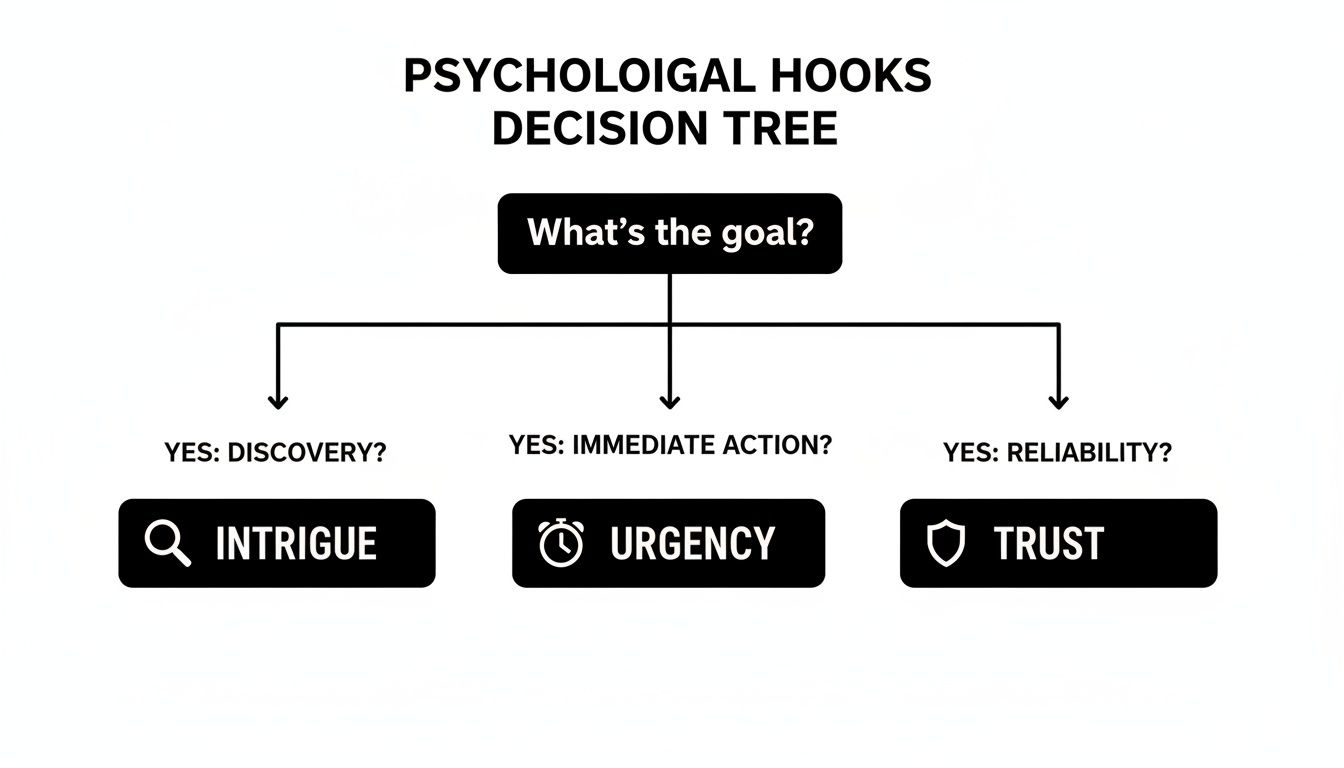
This decision tree shows how your core objective—whether it's generating intrigue, creating urgency, or building trust—should guide your choice of hook.
Choosing the right framework for the right goal is a game-changer. Here’s a quick breakdown to help you match your objective to the perfect hook-writing approach.
Hook Frameworks for Different Creator Goals
| Creator Goal | Recommended Hook Framework | Why It Works |
|---|---|---|
| Solve a specific pain point | Problem-Agitate-Solve | Directly addresses a known frustration, making your solution feel essential and timely. |
| Establish authority | Direct Challenge | Positions you as an expert who can identify and fix common mistakes, building credibility. |
| Drive high engagement | Unexpected Outcome | Creates an irresistible curiosity gap that makes viewers want to comment and learn your secret. |
| Promote a product/service | Problem-Agitate-Solve | Builds a strong emotional case for why your offering is the necessary solution to their problem. |
| Go viral or shareable | Unexpected Outcome | Surprising, counter-intuitive results are highly shareable because people want to show others. |
Ultimately, the best creators don't just stick to one framework. They have a toolbox of different approaches and know which one to pull out for the right job. Experiment with all of them to see what resonates most with your unique audience.
How to Adapt Your Hook for Each Platform
A killer hook isn't one-size-fits-all. I see it all the time: a creator crafts an opening that absolutely crushes it on TikTok, only to see it completely flop on Instagram or X. Why? Because every platform has its own culture, its own algorithm, and its own audience expectations.
To truly master the hook, you have to become a chameleon. Thinking you can just copy and paste content across platforms is one of the fastest ways to kill your reach. The real skill is learning the native "language" of each app and tailoring your first three seconds to speak it fluently.
TikTok Hooks: All About Speed and Sound
TikTok is pure, uncut energy. The algorithm rewards immediate watch time, and users have the fastest scroll-trigger-finger in the game. Your hook has to be a lightning strike—visually dynamic, incredibly fast, and plugged directly into what's happening right now.
For TikTok, your strategy needs to be built on:
- Fast Cuts and Motion: Don't even think about starting with a static shot. It's a death sentence. Kick things off with a jarring transition, a whip pan, a quick zoom, or some kind of immediate physical movement.
- Trending Sounds: A trending audio can be the hook. It gives people instant familiarity and context, making them stick around just to see your take on the trend.
- Bold On-Screen Text: Let the text do the heavy lifting. Slap a bold, punchy question or a shocking statement on the screen in the very first frame to grab attention while the visuals supply the energy.
A great TikTok hook should feel like you've been dropped right into the middle of the action. There’s no room for a slow burn; the payoff has to be immediate.
Instagram Reels: Polished Visuals and Storytelling
While Reels is also a short-form video powerhouse, the vibe is different. The audience here generally appreciates higher production quality, a more curated aesthetic, and a bit more of a narrative. Your hook needs to reflect that polish.
The magic formula is combining stunning visuals with a compelling story. This is where AI tools can really give you an edge. For instance, you could use CreateInfluencers to generate a hyper-realistic AI avatar for a dramatic "before and after" reveal. Or, you could use an "Old Money" photo pack to instantly establish a luxurious, aspirational mood in the very first frame.
You can dive deeper into building this kind of presence by learning how to grow Instagram organically.
The best Instagram hooks promise both beauty and substance. They signal high value through visual quality while creating a curiosity gap that pulls the viewer into a story.
X (Twitter): Text-Driven Value and Authority
On X, your hook is almost entirely text. You have just a handful of characters above the fold to stop someone dead in their tracks. It's a game of sharp, high-impact language that either delivers instant value or sparks a ton of curiosity.
I’ve seen hooks on X work wonders when they follow these patterns:
- Contrarian Takes: Start with a bold claim that challenges conventional wisdom. Something like, "Everyone is dead wrong about how to write a thread hook..."
- Startling Statistics: Open with a powerful number that makes people pause. Think, "90% of creators fail because they completely ignore this one metric."
- Direct Questions: Get the reader's brain working by asking a question they can't help but want to answer.
Your goal here is simple: make your first sentence so compelling that clicking "See more" feels like a necessity, not a choice.
OnlyFans Previews: The Art of Compliant Teasing
For creators on platforms like OnlyFans, the hook serves a critical business function: it has to drive traffic from mainstream social media without getting you banned. This is a delicate balancing act between alluring and compliant.
Your hook must be suggestive enough to convert but "safe for work" enough to stay up. This is where creative AI becomes a superpower. Using a tool like CreateInfluencers, you could generate a whole series of images from a 'boudoir' photo pack.
From there, you can stitch them into a stunningly suggestive—but fully compliant—Instagram Reel. Imagine a fast-paced slideshow of beautifully lit, artistic shots that hint at the exclusive content without showing anything explicit. Pair that with a hook like, "The photo set they didn't want you to see..." and you create massive intrigue while keeping your promotional accounts safe.
Suddenly, your hook isn't just an attention-grabber; it's a powerful and compliant sales funnel.
Using AI to Supercharge Your Hook Creation
Knowing the theory is one thing, but actually putting it into practice is what gets results. You can understand the psychology behind a killer hook all day, but you still have to create it—and do it over and over again. This is precisely where AI stops being a tech buzzword and starts being your secret weapon.
Tools like CreateInfluencers aren't just for brainstorming. They let you generate the actual visual assets for your hooks in minutes, not hours. We're talking about moving from a vague idea to a polished, scroll-stopping piece of content that used to require a whole production team. Let me show you exactly how it's done.
Transform a Selfie into a Shocking Hook
One of the oldest tricks in the book is the "before-and-after," and for good reason: it works. It creates an instant curiosity gap, making people stick around just to figure out how you got from point A to point B. With AI, you can crank this concept up to eleven without any makeup artists or wardrobe changes.
All you need is a simple, clear selfie. From there, the CreateInfluencers platform can take that base image and run wild with it.
- First, you upload your selfie to create your character model.
- Next, you prompt the AI to generate a new image of that character in a totally different aesthetic. Think going from your everyday look to a high-fashion "Old Money" vibe or a gritty cyberpunk version of yourself.
- Finally, just place the two images side-by-side in your video editor.
The result is a visually stunning comparison that makes for a perfect video opener. Add a text overlay like, "I gave myself a $10,000 makeover in 10 seconds," and you've got a hook that's almost impossible to scroll past. It's a clever visual lie that tells a deeper truth about what’s possible with today’s technology.
By using your own face as the starting point, the AI-generated result feels surprisingly personal, even when it’s completely fantastical. This blend of real and unreal is what really grabs people.
Create Authentic Reactions with Voice-Driven AI
Reaction videos are another classic format that consistently performs well. There's something magnetic about seeing a raw human emotion—shock, laughter, disbelief—that makes us want to see what caused it. But you don't always have to film yourself reacting to something live. AI offers a smarter, more direct shortcut.
CreateInfluencers has a feature that uses your own voice to guide image generation in real time. Let’s say you want to make a hook about a wild news story.
Instead of just talking to the camera, you can record a voiceover of yourself yelling, "No way, I can't believe this actually happened!" The AI analyzes the emotion and energy in your voice to generate an avatar with a perfectly timed shocked or amazed expression. This whole process is a cornerstone of modern AI content creation for social media, turning simple audio into a powerful visual punch.
This technique gives your content a real sense of immediacy. The image looks like an authentic, in-the-moment reaction, making the hook feel far more genuine than a stiff, pre-recorded clip.
Establish a Vibe Instantly with Themed Photo Packs
Sometimes the best hook isn't a single shocking image but an immediate and powerful mood. You want to stop the scroll by instantly signaling what your content is about. This is where themed photo packs become an absolute game-changer.
Imagine you’re an adult content creator promoting your OnlyFans on Instagram or X. You can't post anything explicit, but you still need to project an air of allure and exclusivity.
- The Goal: Create a hook that’s both safe for work and incredibly enticing.
- The Tool: Use a themed pack like the "boudoir" or "Tinder" photo sets in CreateInfluencers.
- The Execution: You can generate a dozen high-quality, artistic images that capture an intimate mood without ever crossing platform guidelines. Then, just stitch them into a fast-cut Reel.
The hook is the immediate vibe shift. A user scrolling through endless memes suddenly sees this moody, professional, and intriguing video. It’s different. It stands out. Pair it with a text overlay like, "What you're missing out on..." and you create a powerful sense of FOMO that drives people straight to your profile.
For creators looking to speed things up even more, you can pair these visual techniques with other specialized tools. Many find that AI Post Generators are great for handling the text-based parts of their posts, freeing them up to focus on the visuals. In the end, using AI isn't about replacing your creativity; it's about amplifying it and getting your best ideas out into the world faster than ever.
A Few Common Questions About Hooks
Even when you've got the frameworks down, writing a killer hook isn't always straightforward. As you start putting this stuff into practice, you're going to run into some specific challenges. Let's walk through some of the questions I get asked all the time so you can troubleshoot on the fly.
This isn't about theory anymore. This is about practical, real-world problem-solving. Think of this as the field guide for when you're in the trenches, trying to make your content pop.
How Can I Tell If My Hook Is Actually Working?
The truth is in your analytics—specifically, the audience retention graph. For video, a really strong hook shows a slow, gentle decline over the first 3-5 seconds. If you see a massive, cliff-like drop right at the beginning, that's your hook failing to connect.
With static posts, like an image or text on X, it’s all about that initial burst of engagement. A wave of likes, comments, and shares within the first hour tells you the hook did its job and stopped the scroll.
But honestly, the most definitive way to know is to A/B test.
- Make two versions: Start with the same core piece of content but create two totally different hooks for it.
- Check the initial data: Look at how both posts perform in the first 24 hours. Compare the views, watch time, and engagement.
- Find the winner: The numbers won't lie. One hook will almost always outperform the other, telling you exactly what your audience prefers.
Doing this takes the guesswork out of the equation. You're no longer hoping something works; you're building a repeatable process based on what your specific audience actually wants.
Is There a Line Between a Good Hook and Just Being Clickbait?
Oh, absolutely. And it’s a line you never want to cross. A provocative or controversial hook can definitely get you those initial eyeballs, but it will backfire spectacularly if the content doesn't deliver on the promise.
When your hook sets an expectation that your content doesn't meet, you get abysmal watch time, a comment section full of angry people, and you start to erode any trust you've built. The goal of a social media hook is to be captivating, not deceptive.
A hook is a promise. Clickbait is a lie. One builds an audience, the other burns it down. Your long-term success hinges on knowing the difference and honoring the trust people give you in those first few seconds.
Before you hit publish, just ask yourself this: "Does my content actually deliver on the bold claim my hook is making?" If there's any hesitation, rewrite the hook. Authenticity is everything.
What Do I Do When I Have Creator's Block and Can't Think of a Hook?
Creator's block is real, and it happens to everyone. The key is not to just sit there and wait for inspiration to strike. You have to actively go find it. When I’m stuck, here are a few things I do that almost always work.
First, I go into consumption mode. I'll spend a solid 15-20 minutes just scrolling through trending content on TikTok or Reels. But I'm not just watching; I’m analyzing. What’s the structure of the hooks that are going viral? What questions are they asking? What surprising statements are they making?
Next, I look at my own work. I'll dive into my analytics and pull up my best-performing posts from the last six months. I break down their hooks piece by piece. What did they have in common? Is there a pattern I can borrow and apply to a new topic?
Finally, I lean on frameworks to get my brain moving.
- Go back to basics: I’ll pick one of the frameworks we covered, like Problem-Agitate-Solve, and just force myself to come up with five ideas that fit that mold. No judgment, just brainstorming.
- Spark ideas visually: Sometimes, you just need a different kind of prompt. I’ll use a tool like CreateInfluencers to generate a few AI characters in unique scenarios. Seeing a visual—like an avatar in a cyberpunk city or with an "Old Money" aesthetic—can instantly trigger a new story or angle I hadn't thought of.
That combination of outside inspiration and structured thinking is usually enough to break through any creative rut.
Ready to stop the scroll and create hooks that captivate your audience from the very first second? With CreateInfluencers, you can generate stunning AI avatars, dynamic video openings, and unique visuals that give your content an undeniable edge. Sign up for free and start creating your first scroll-stopping hook today!